by Gulf Offshore | Jul 24, 2026 | news

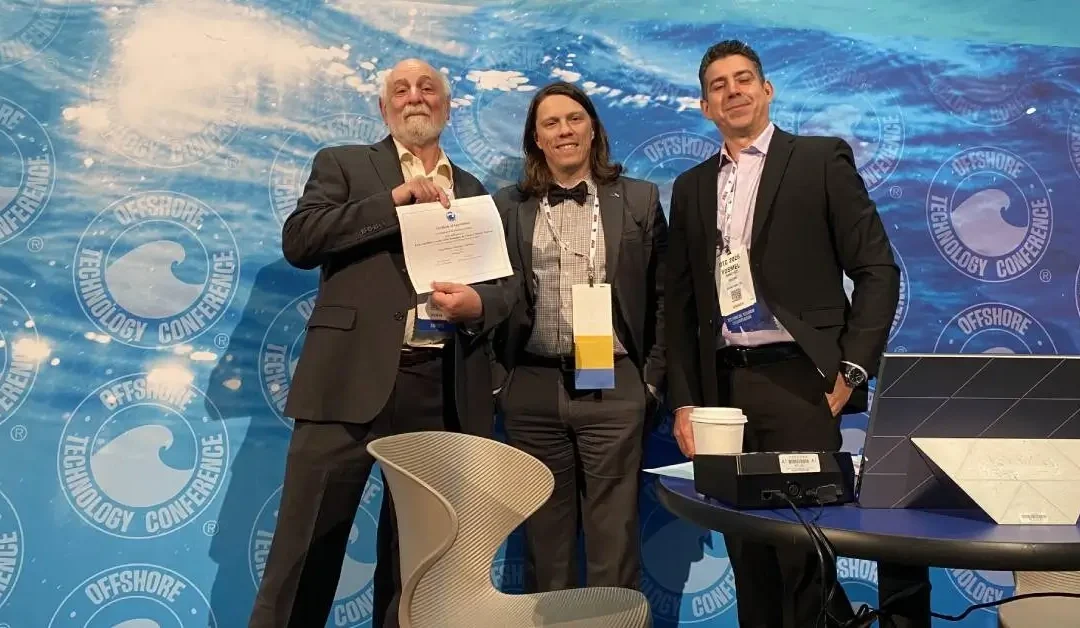
At this year’s Offshore Technology Conference, GORI Technical Director Alan Cohen presented “From Liabilities to Assets: GORI Reimagines the Future of Offshore Platforms” (OTC-36975-MS), a paper he co-authored with Executive Director Kent Satterlee. The presentation shared GORI’s plan for turning aging Gulf oil and gas platforms into multi-use hubs for energy, critical minerals, aquaculture, and ocean data monitoring.
The timing lined up with big news. The National Academies of Sciences, Engineering, and Medicine had just awarded GORI $20 million to help get this work off the ground. Roughly 1,300 Gulf platforms remain today, and 100 to 150 are removed every year. GORI’s approach turns that around, converting infrastructure slated for removal into revenue-generating, resilient assets instead. Starting with five pilot platforms, including South Pass 83, the team is proving out a scalable model that strengthens U.S. energy security, supply chains, and coastal economies, while also building pathways for workforce training and re-employment.
It’s a strong sign of momentum for GORI’s five-year plan to turn five Gulf platforms into regional assets that support jobs, clean energy, and domestic mineral supply chains.
by Gulf Offshore | Apr 23, 2026 | news
From Liabilities to Assets: GORI Reimagines the Future of Offshore Platforms
Gulf Offshore Research Institute wins $20 million Gulf Futures Challenge award to transform offshore platforms into hubs for energy, food, and ocean monitoring
MANDEVILLE, La. – April 23, 2026 – More than 1,300 offshore oil and gas platforms across the Gulf Coast region face decommissioning — and with them, the potential loss of thousands of jobs, a significant drop in reef fisheries biomass, and billions in revenue for Gulf Coast communities. Today, the Gulf Offshore Research Institute (GORI) announced it has been selected as one of only two recipients of a $20 million award through the National Academies of Sciences, Engineering, and Medicine (NASEM) Gulf Futures Challenge — funding that will transform these aging structures from liabilities into hubs for clean energy, sustainable seafood production, critical mineral recovery, and real-time ocean monitoring.
The Gulf Futures Challenge, led by NASEM’s Gulf Research Program (GRP), invests in bold, community-centered solutions to the Gulf region’s most pressing challenges in energy transition, environmental change, and community resilience. GORI’s award will support a five-year effort to retrofit and operationalize five offshore platforms, with permitting already underway through the Bureau of Ocean Energy Management.
GORI’s proposal — Repurposing Petroleum Infrastructure for Sustainable Energy, Food, and Critical Minerals — turns existing offshore structures into engines for the blue economy. By leveraging these structures as vertical reef ecosystems, the project protects marine biodiversity while creating new, innovative industries. This approach expands seafood production, supports renewable energy and mineral recovery, and strengthens coastal communities historically dependent on oil, gas, and fishing industries.
“We are transforming the backbone of oil and gas production into a more sustainable and prosperous Gulf Coast. By integrating renewable energy, aquaculture, mineral recovery, and ocean monitoring, we strengthen marine habitats, support thriving ecosystems, boost coastal economies, and advance sustainable energy production,” said Kent Satterlee, Executive Director of GORI.
“We are delighted by the national acknowledgement of the importance of offshore infrastructure in sustaining essential marine habitats, while simultaneously highlighting the potential to advance a thriving and sustainable blue economy supporting coastal communities in the Gulf,” said Rob Fondren, Co-Founder and Chairman of GORI.
“Offshore platforms already support flourishing ecosystems below water, while at the same time serving as infrastructure for the blue economy in the Gulf Region. Repurposing them offers a once-in-a-lifetime opportunity to leverage existing assets and avoid the massive cost of replacement,” said Dr. Greg Stunz, Senior Executive Director, Harte Research Institute.
“Choosing the right platforms is the foundation of this entire effort. Through FishLAT, our machine learning assessment tool, we can screen all 1,300 platforms in the Gulf and match each one to its highest-value reuse — whether that’s aquaculture, renewable energy, or ocean monitoring. This moves platform repurposing from a concept to a data-driven, defensible decision,” said Amber Sparks, Co-Founder of Blue Latitudes LLC and GORI partner.
Project Partners
What makes this project distinctive is the breadth of expertise assembled under a single initiative — spanning marine science, offshore engineering, renewable energy, aquaculture, critical mineral recovery, and community workforce development. No comparable multi-benefit strategy has previously been attempted at this scale in U.S. waters. The project brings together a multidisciplinary team, including:
- Harte Research Institute (HRI) at Texas A&M University–Corpus Christi — expertise in fisheries, socioeconomics, and marine policy and law
- Blue Latitudes, LLC — a women-owned marine environmental consulting firm specializing in offshore work and Rigs to Reefs planning
- University of Southern Mississippi and Louisiana State University — advancing open-ocean aquaculture, hydrographic science, and uncrewed ocean monitoring
- University of Houston — specializing in offshore hydrogen production and energy transition feasibility (ROICE Program) and workforce development
- University of Michigan — pioneering sustainable critical mineral extraction from seawater
- Gulf Trust — advancing solutions that unite industry, environment, and communities
- The FerVID Group — assessing geothermal energy potential in offshore reservoirs
- Blue Silo Aquaculture, LLC — specializing in platform-assisted open-ocean aquaculture
Work begins with platform permitting, stakeholder engagement, and structural assessments. An offshore platform located off the Mississippi River delta in 470 feet of water will serve as the flagship demonstration site, with aquaculture and critical mineral pilots, ocean monitoring systems, and renewable energy testbeds to follow in Years 3 through 5. By 2030, GORI expects to have five operational platforms producing measurable environmental, economic, and social returns — and a replicable playbook for the remaining structures across the Gulf Coast region.
For more information about GORI’s work, visit www.gulfoffshoreresearch.com.
Media Contact:
Sara Hamann
Communications Director
Gulf Offshore Research Institute
sarah@gulfoffshoreresearch.com
by Sara Hamann | Oct 8, 2025 | news
Advancing the Viability of Oil Rig–Associated Aquaculture in the Gulf of Mexico
In partnership with the Gulf States Marine Fisheries Commission, Innovasea Systems, NOAA, and the University of Miami, the Gulf Offshore Research Institute (GORI) conducted an in-depth study to advance offshore aquaculture on decommissioned oil platforms.
Building on earlier feasibility work at Station Padre, this 2023 report presents new research on species selection, engineering design, environmental modeling, and economic potential for platform-assisted aquaculture. Using the Aquaculture Performance Index (APIX), the study identified Red Drum and Florida Pompano as the most viable species for offshore production.
Modeling showed that the concept—integrating fish, seaweed, and shellfish through an Integrated Multi-Trophic Aquaculture (IMTA) system—can be both environmentally sustainable and economically competitive. A financial analysis projected positive returns within 4–7 years under scalable operations, while deposition modeling confirmed minimal ecological impact.
The report concludes that repurposing retired oil and gas platforms could provide a transformative pathway for expanding U.S. seafood production, reducing imports, and supporting a sustainable blue economy in the Gulf of Mexico.
Final GORI Report to GSMFC Offshore Aquaculture May 17 2023
by Sara Hamann | Oct 8, 2025 | news
MMEERSET Phase One: Developing Platform-Based Offshore Aquaculture in the Gulf of Mexico
The Gulf Offshore Research Institute (GORI), in collaboration with Louisiana State University, LUMCON, NOAA, and Innovasea Systems Inc., conducted a groundbreaking feasibility study on repurposing retired oil and gas platforms for sustainable offshore aquaculture in the Gulf of Mexico.
The project evaluated two former platform sites near North Padre Island, Texas—known as Station Padre—to determine economic viability, spatial suitability, and environmental conditions for establishing multi-use aquaculture operations. Results showed that cobia production could be cost-competitive under realistic scenarios, while red drum presented greater challenges. Environmental data collected confirmed that the site experiences high-energy open-ocean conditions suitable for advanced submersible aquaculture systems.
This study represents a critical first step toward integrating seafood production, renewable energy, and ocean conservation within existing offshore infrastructure—paving the way for sustainable blue economy growth in the Gulf region.
GORI’s MMEERSET Phase One project explores how Gulf oil and gas platforms can support sustainable offshore aquaculture. Focusing on Station Padre, the study found strong economic potential for cobia culture and identified 77% of the area as suitable for future development.
GORI Final Report to GSMFC – January 30, 2021
